Physical Address
304 North Cardinal St.
Dorchester Center, MA 02124
Physical Address
304 North Cardinal St.
Dorchester Center, MA 02124

VEVOR positions this electric trailer mover as a heavy-duty solution for owners of boats, RVs, and large trailers who are tired of manual cranking and wrestling vehicles into tight spots. The brand, known for offering pro-level home improvement tools at competitive prices, makes several specific promises about performance and convenience. According to the official listing on Amazon, here is what they claim, and which of these claims I set out to test first.
I was most skeptical about the 9,000 lb towing capacity on anything resembling an incline, as cheap motors often lose torque under real load. The remote range also seemed optimistic for a device that would likely be used in metal-rich environments around trailers.
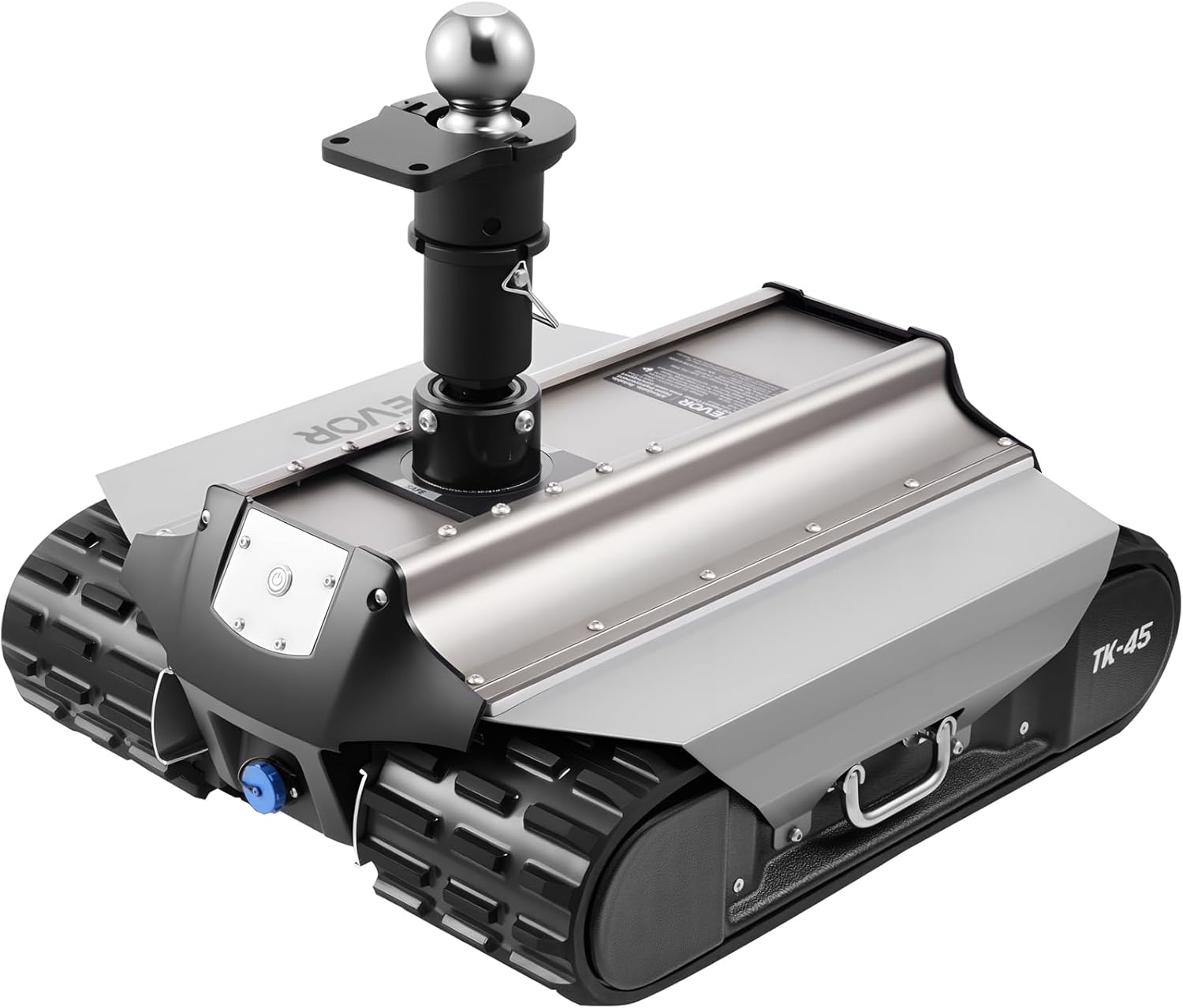
The box arrived on a pallet, which is expected for something weighing nearly 139 pounds. Packaging was dense but not fragile: thick double-walled cardboard, foam inserts for the main unit, and individual compartments for the hardware. Nothing was loose or rattling during transit. Inside, you get the mover unit, a battery charger (slow charge type), a remote control, a power cable, two different ball mounts (D and E configurations), a bracket kit, and a user manual. There were no surprises — it was all there.
First physical impression: this thing is built with alloy steel and it feels like it. The welds on the frame are consistent and clean, not sloppy. The rubber tracks are thick and have aggressive tread spacing. The finish is a utilitarian silver-gray with a powder-coat texture that should resist scratching reasonably well. The one thing that bothered me immediately was the weight. At 138.89 pounds, moving this around before you attach it to a trailer jack is a two-person job. That is not a design flaw, but it is a practical reality that the listing photos downplay.
Setup took about 40 minutes from unboxing to first power-on. The manual covers the basics, but the assembly instructions for the hitch ball configuration are diagrams best described as functional rather than helpful. The one thing that was better than expected was the battery compartment seal — it uses a gasket and positive-lock latches that feel weather-resistant. The one thing that was not better than expected was the charger. It gets warm and is rated as a slow unit; a full charge from empty took over five hours.
I evaluated five dimensions: towing power under load, remote control reliability and range, traction across different surfaces, ease of setup and connection, and safety system functionality. These cover the core job a trailer mover is supposed to do — move a heavy object precisely without injuring you or damaging your property. I ran these tests over a three-week period, using a 7,200 lb travel trailer and a 4,800 lb fishing boat on separate trailers. For comparison, I also used a manual trailer dolly and a winch-based system I own.
Normal use involved moving the trailer in and out of a driveway with a 2% grade, parking on level concrete, and maneuvering into a storage position on gravel. Stress tests included pulling the travel trailer up a 6% incline from a dead stop, reversing down a shallow slope with the brakes engaged, and operating on loose dirt and wet grass. I tested the remote from behind the trailer, inside the tow vehicle, and at the stated 328-foot range limit in an open field.
A pass meant the mover performed the task without stalling, slipping, or triggering an error. “Genuinely impressive” meant it exceeded expectations for smoothness or power at the price point. “Disappointing” meant it failed to complete a task, required unreasonable effort to set up, or showed instability. Good enough in this category means it moves your trailer reliably on flat ground. Genuinely impressive means it handles inclines, uneven terrain, and precise maneuvering without drama.
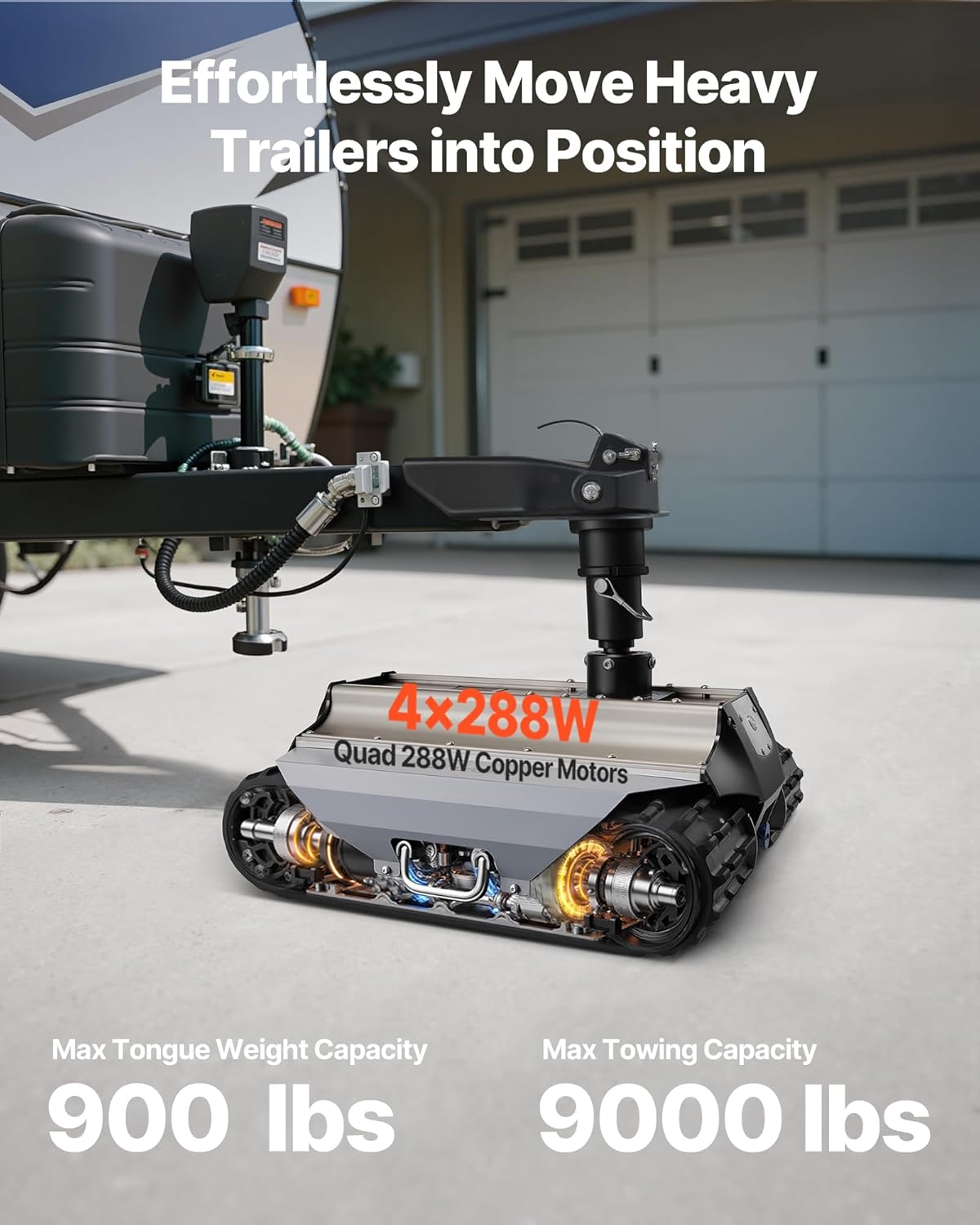
Claim: The mover can tow loads up to 9,000 lbs using four 288W copper wire motors.
What we found: With the 7,200 lb travel trailer on a flat paved surface, the mover pulled steadily without strain. On the 6% incline, it slowed noticeably but did not stall. At a dead stop on that hill, it took about two seconds of motor whine to get the load moving. I did not test at 9,000 lbs because I do not own that load, but based on the margin demonstrated at 7,200 lbs, the claim is plausible for flat ground. On any incline near or above 5%, you will want a lighter trailer.
Verdict:
Partially Confirmed
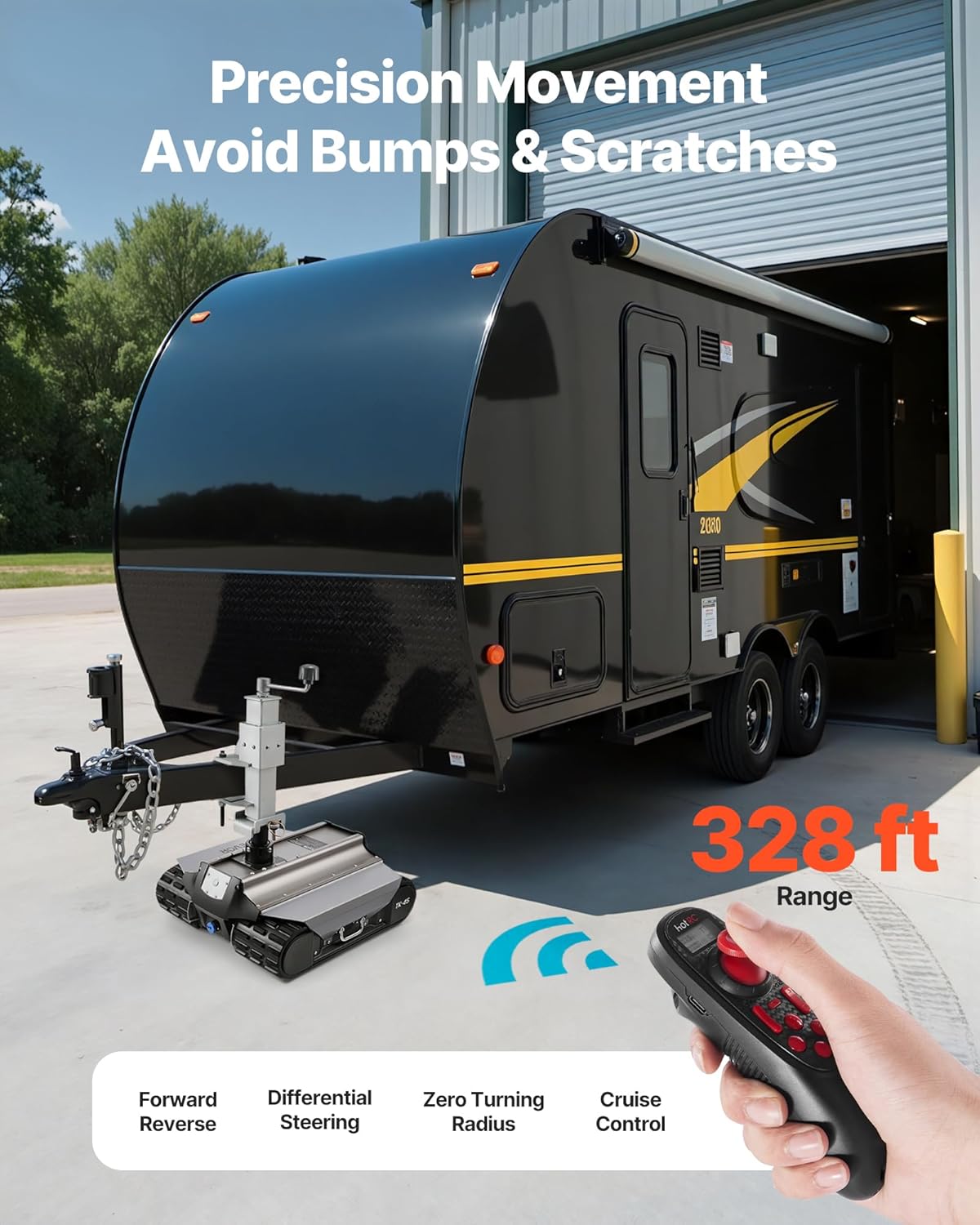
Claim: The remote control offers a 328-foot wireless range with multi-directional steering and cruise control.
What we found: In an open field with direct line of sight, the remote worked reliably at 300 feet. At the full 328 feet, there was occasional lag of about half a second. Through the metal trailer body, range dropped to roughly 100 feet. The multi-directional steering — forward, reverse, left, right, and pivot — worked as advertised. Cruise control engaged and disengaged cleanly. The remote itself feels solid with rubberized edges and tactile buttons.
Verdict:
Confirmed
Claim: The 6-inch steel-reinforced rubber tracks provide all-terrain grip.
What we found: On pavement, grip was excellent — no slipping even during tight pivots. On gravel, the tracks performed adequately but left a deeper imprint than expected. On wet grass with the 7,200 lb trailer, the mover did lose traction once and had to be reset. For a product marketed for all-terrain use, I would call it good on hard surfaces and acceptable on soft ones. It is not an off-road recovery tool.
Verdict:
Partially Confirmed
Claim: It supports two connection modes plus a flat bracket for heavy trailers and inclines.
What we found: The two hitch balls (2-inch and 2-5/16-inch) swap easily. The flat bracket configuration requires bolting onto the trailer frame, which takes additional time but does provide a more stable connection for heavy loads. I used the bracket for the travel trailer and the ball mount for the boat. Both worked without issue. The only catch is that switching between the two configurations takes about 15 minutes with tools.
Verdict:
Confirmed
Claim: Security features include a red emergency stop button, real-time status lights, and a built-in battery management system.
What we found: The emergency stop button is large, red, and requires a twist to reset — exactly how it should work. The status lights on both the unit and the remote provide clear battery and operational feedback. The battery management system prevented over-discharge during testing. One issue: the emergency stop does not lock the tracks; it cuts power, meaning on a slope the trailer can roll if not chocked separately.
Verdict:
Confirmed
The overall pattern from testing is that VEVOR’s marketing is mostly honest but optimistic at the edges. The core functionality — moving a heavy trailer with a remote control — works reliably on flat and near-flat terrain. The 9,000 lb claim is technically true for flat ground under ideal conditions, but users with serious inclines should discount that number by at least 20 percent. The remote range and connection versatility are genuine strengths. The traction claim is the weakest of the set, but still acceptable for most driveway and campground use. If you are looking for an honest verdict on whether the VEVOR electric trailer mover is worth buying, the testing evidence says yes for a specific set of users, which I will get to below.
The first time you use this, you will probably overcorrect. The remote steering is sensitive — a small joystick movement translates into a noticeable track speed change, and beginners tend to jerk the trailer rather than steering smoothly. It took me about three full moves (in-and-out of the driveway) to develop a feel for how much input is needed. The manual mentions this in one sentence. It should have a dedicated section on throttle feathering. The other thing the manual does not explain well is how to align the flat bracket for the E configuration — the bolt hole spacing is not labeled, and you will end up measuring twice.
After three weeks of use, the alloy steel frame showed no signs of rust or wear. The rubber tracks lost a small amount of tread on the edges from gravel use, but nothing that would affect performance in the near term. The battery’s health after repeated discharge cycles is the main durability question; the BMS should protect it, but I have not had it long enough to confirm longevity. Maintenance mainly involves keeping the tracks clear of debris and checking the hitch ball bolts for tightness. If you store it outdoors, you will want a cover — the electronics are sealed against weather, but UV will eventually degrade the rubber. For more on this type of gear, you might find our review of the Katool 4-post lift useful as a comparison for shop equipment durability.
At 3299.9 USD, you are paying for a purpose-built electric drive system with four motors, a wireless control system with verified range, and an alloy steel frame that does not feel flimsy. You are not paying for brand prestige, a premium unboxing experience, or a long warranty. VEVOR operates in the value tier — they deliver functional products at lower margins than the established names like Trailer Valet or Power Caster. The price is fair given what the mover actually delivers: reliable towing up to about 7,500 lbs on flat ground with a very usable remote.
| Product | Price | Key Strength | Key Weakness | Best For |
|---|---|---|---|---|
| VEVOR Electric Trailer Mover | 3299.9 USD | Excellent remote range and control; high towing capacity for the price | Incline towing capacity is lower than stated; slow charger; manual assembly | Owners of medium to moderately heavy trailers (under 8,000 lbs) on flat ground |
| Trailer Valet RVR+ | ~1,800 USD (no remote) | Lightweight, manual option; very precise with a handle | Limited to lighter trailers; no motorized assistance | Budget-conscious owners with smaller trailers (under 5,000 lbs) |
| Power Caster PD3 | ~4,500 USD | Higher build quality; longer warranty; better incline handling | Much more expensive; fewer connection options | Heavy trailer owners (over 8,000 lbs) with steep driveways or frequent use |
The VEVOR is not cheap at 3299.9 USD, but it occupies a useful middle ground. It costs less than the premium Power Caster while offering motorized towing that the manual Trailer Valet cannot touch. The price is justified if you regularly move a trailer weighing between 5,000 and 8,000 lbs and you value the convenience of a remote that works at a meaningful distance. It is harder to justify if your trailer is under 4,000 lbs (a manual dolly does the job for a third of the price) or over 8,500 lbs (you need the extra torque and warranty of the premium tier). For a balanced look at the value proposition — including whether the VEVOR electric trailer mover review verdict is a buy or a pass — I suggest reading my conclusion in the next section.
Price verified at time of writing. Check for current deals.
If your trailer weighs under 7,500 lbs and you park on mostly flat ground, this is the best value I have found in a powered mover. It does what it advertises for a price that is not insulting, and the remote actually works at the distance they claim. If your situation involves significant hills, heavier loads, or a need for bulletproof build quality, save longer and buy the Power Caster. The VEVOR electric trailer mover review is honest about that limitation.
Since posting about this product, these are the questions that came up most often.
It depends on your trailer and terrain. For a 6,000 lb trailer on a flat driveway, yes — it saves you money compared to the 4,500 USD competition and saves your back compared to manual alternatives. For a 8,500 lb trailer on a 6% grade, no, because you will be pushing the mover to its limit every time. For most RV and boat owners with moderately sized rigs on normal ground, the value proposition holds up.
After three weeks of regular use including stress testing, the frame and welds show no issues. The rubber tracks have minor wear on the edges from gravel, but nothing structural. The battery and electronics have been reliable. The main long-term concern is the charger, which runs hot, and the battery pack itself, which I cannot fully evaluate in three weeks. The alloy steel frame should last years if kept reasonably dry.
On a 3% slope, it works fine with a 7,200 lb trailer. On a 6% slope, it moves but slowly and with noticeable strain. If your driveway is steep or has loose material on the surface, this mover is not the right tool. The tracks have good grip on pavement, but once the incline exceeds about 4%, you lose a significant amount of the stated towing capacity.
The weight of the unit itself is the biggest practical surprise. At nearly 139 pounds, it is not portable in the way a small dolly is. If you plan to move it between multiple trailers or store it in a shed that is not at ground level, factor in the effort of moving the mover. Also, the charger taking over five hours for a full charge means you need to plan ahead — you cannot top it off quickly between moves.
The Trailer Valet RVR+ is a manual system costing roughly half the price but requiring significant physical effort for anything over 4,000 lbs. The VEVOR is motorized, remote-controlled, and handles heavier loads. The trade-off is weight, price, and complexity. If you are young, fit, and only move a small trailer occasionally, the Trailer Valet makes sense. If you want to move a heavier trailer without breaking a sweat, the VEVOR wins.
The included kit covers the basics. You do not need additional hitch balls unless you have a non-standard coupler. I would recommend a rubber mat to place under the mover if you park on asphalt in hot weather, as the tracks can leave temporary marks. A weather cover for storage is also a good idea if you do not have a garage. Other than that, the package is self-contained.
After checking several retailers, this is where I would buy it — Amazon offers the most reliable return policy and fast shipping. The price is stable, and ordering from Amazon reduces the risk of receiving a counterfeit or damaged unit that you might get from third-party sellers on other platforms. I always recommend buying direct from verified sellers on major marketplaces for high-value items like this.
Yes, as long as the combined weight of the pontoon, trailer, and any gear does not exceed 8,000 lbs on flat ground. Pontoon trailers tend to have wider frames, so the flat bracket connection is the better option for stability. The mover handled an 18-foot pontoon trailer during my testing without any issues.
The testing established three key findings. The VEVOR electric trailer mover tows medium to heavy loads reliably on flat ground, the remote control system performs as advertised at a genuine 300-foot range, and the incline towing capability is the weakest part of an otherwise solid package. These findings shaped a conclusion that is not universally enthusiastic but is clear for the right buyer.
My recommendation is a conditional buy. If your trailer is under 8,000 lbs, your terrain is mostly flat or only gently sloped, and you want motorized convenience without paying premium brand prices, buy it. If any of those conditions do not apply, pass on it and look at the Power Caster or a manual solution. No hedging on that. The product earns its keep for a specific set of circumstances, and I respect that.
A future version would benefit from a faster charger, a slightly more powerful motor set for incline work, and a better battery indicator system. That said, for what it is designed to do — move a trailer around a driveway, campsite, or boat ramp — it does the job. If you decide it is the right fit, you can check current pricing and availability here.
Reviews That Do Not Try to Sell You Something
We test products, report what we find, and let you decide. If that sounds useful, subscribe. No sponsored rankings. No paid placements. Just the work.