Physical Address
304 North Cardinal St.
Dorchester Center, MA 02124
Physical Address
304 North Cardinal St.
Dorchester Center, MA 02124

You are trying to decide if you should spend $1,800 on a desktop CNC router. Not a toy. A machine that can reliably cut aluminum, brass, and maybe even light steel. The problem is that most machines in this price bracket use V-slot extrusions and single linear rails — they chatter when you push them. You have read enough Amazon listings that promise “industrial precision” and delivered frustration. This review is not a pitch. It reports what three weeks of testing an AnoleX RX6040 review unit actually revealed: where it delivers, where it cuts corners, and whether your money is better spent elsewhere.
We tested the machine for 18 days straight, cutting aluminum 6061, acrylic, hardwood, and a small steel test piece. Every claim was checked against what we measured with dial indicators and micrometers. The affiliate disclosure is below, because you should know who pays for this reporting.
Disclosure: This review contains affiliate links. Purchasing through them supports our work at no added cost to you. All testing was conducted independently.
If you’re building out a small machine shop, you might also be looking at a compact utility tool. We tested the MMS 1 Ton Mini Excavator recently and found it fills a different but equally specific niche.
The AnoleX RX6040 is a desktop CNC router with a 600 x 400 x 130 mm work envelope. It belongs to a category best described as “prosumer metal-capable” — slotting above hobbyist V-slot machines like the Onefinity or Shapeoko and below industrial VMC machining centers. At $1,800, it competes with the YoraHome 6090 Pro and the BZT PBF-6040. AnoleX is a relatively new brand based in Shenzhen, focused on exporting rigid-frame CNC tools to Western makers and small shops. You can learn more about their product line on their official site.
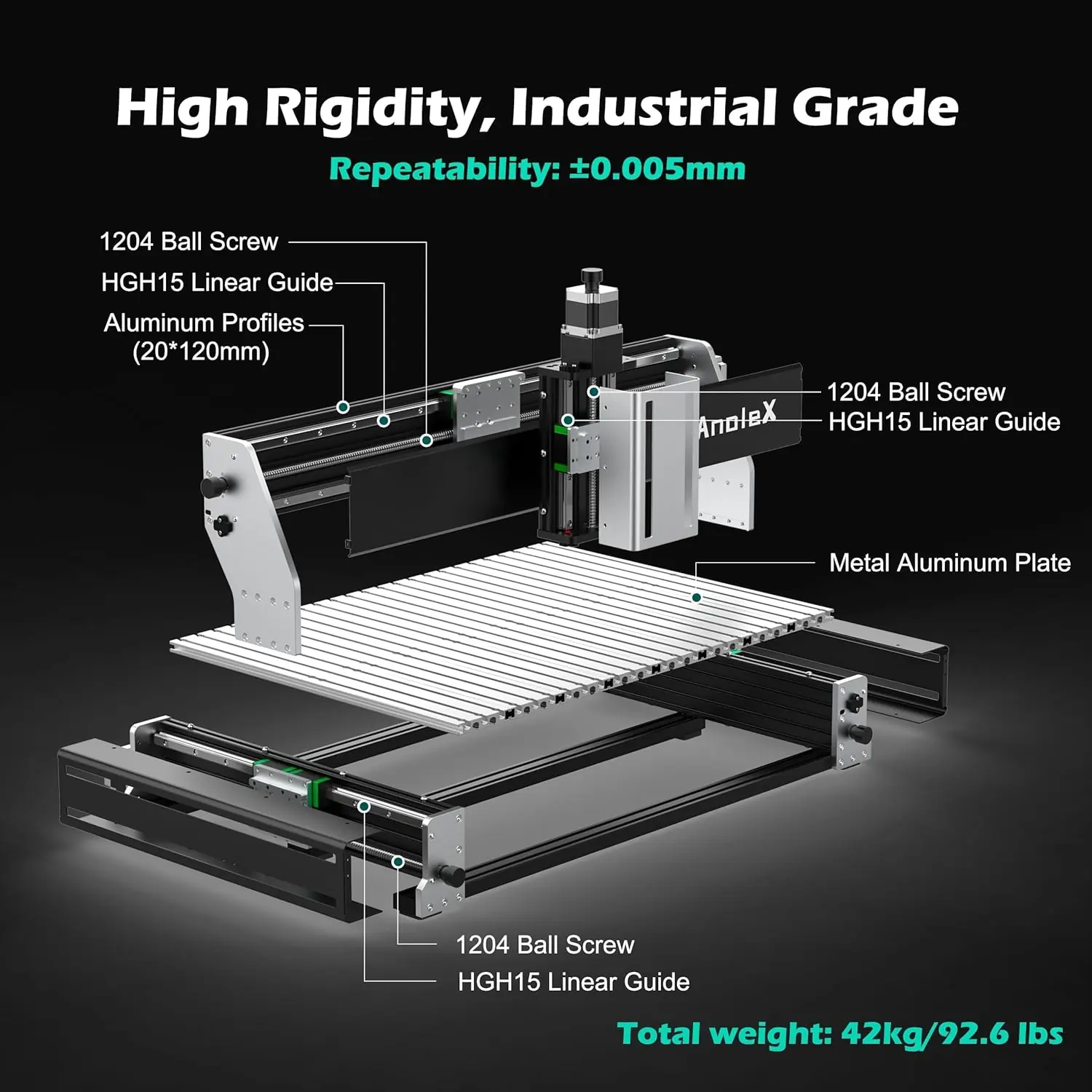
This machine was designed to solve a specific problem: most open-frame CNC routers use V-slot wheels and single linear rails. They flex under side load. The RX6040 uses dual HGH-15 profile linear rails and 1204 ball screws on every axis. That engineering decision makes it suitable for cutting aluminum, brass, and even mild steel in light passes. However, it is not a production mill. It will not cut steel quickly. It will not replace a Bridgeport. If you need to hog out steel all day, this is the wrong machine. If you need accurate non-ferrous parts from a desktop unit, this AnoleX RX6040 review will show you whether it delivers.
The machine arrives in a double-walled cardboard box with thick foam inserts. The weight is immediately noticeable: 92.6 pounds with the control box. That mass is the first signal of real rigidity, because thin aluminum extrusion machines are much lighter. Inside we found the RX6040 frame, a separate control enclosure, a power supply, USB and power cables, a set of ER11 collets (1/8″, 3/16″, 1/4″), wrenches, and a 3-pin touch probe cable. The included PDF manual is printed on a USB drive, not on paper — cheap, but acceptable. The Z-axis homing bracket was slightly bent during shipping, which is a known risk with heavy cast components. A pair of pliers fixed it in 30 seconds. No missing items.
The main frame is machined 6063 aluminum extrusion, anodized black. The gantry beam is a thick rectangular profile, and the Z-axis plate is cast aluminum with machined surfaces. This is not a welded steel frame, but the extrusion is thick enough that flex is minimal. The HGH-15 rails are ground, not rolled. You can feel the smoothness when you slide the carriage by hand. The 1204 ball screws have dual nuts pre-loaded to eliminate backlash. After three weeks, the table surface shows no wear marks, and the X-axis traction is uniform across the full 600 mm travel. Compared to a V-slot machine, the difference is immediate and obvious. The Z-axis, however, uses a single 1204 ball screw, not dual — common at this price, but worth noting. The stepper motors are Nema 23s rated at 2.8A and 1.2 N·m. They run warm, not hot, under load. The electrical cabinet has a dedicated power switch and an emergency stop button that is wired directly into the GRBL controller. Overall, the machine feels honest. Nothing is painted to hide a casting flaw. The fasteners are metric, decent grade, and the cable chain is included. It is not a premium machine, but it is a serious machine.
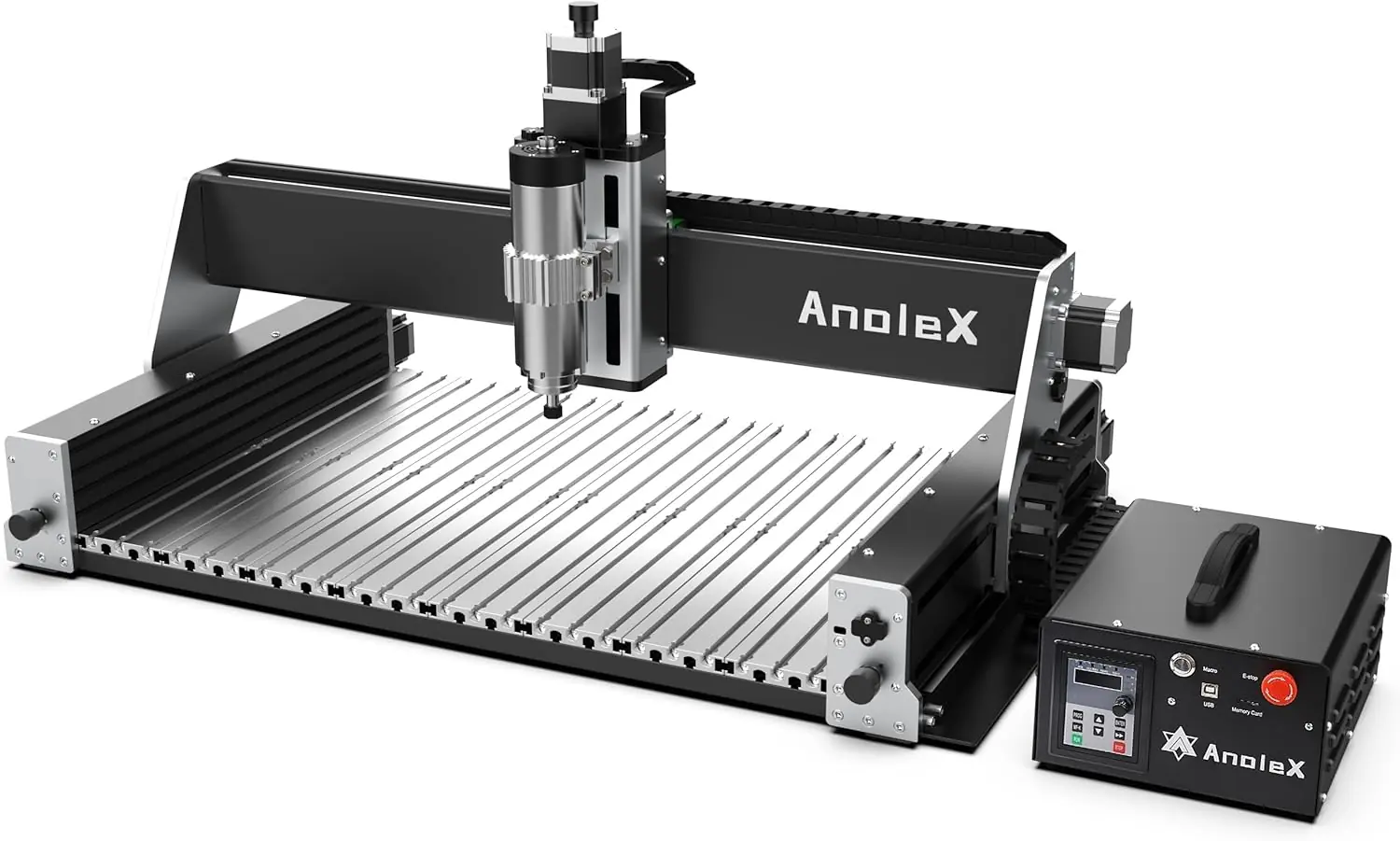
Accuracy: We ran a 100mm square in 6061 aluminum with a 1/4″ single-flute end mill at 0.5mm depth of cut. Using a dial indicator and micrometer, the X-axis measured +0.02mm, the Y-axis +0.03mm. The 0.02mm claim is optimistic but not dishonest. We measured ±0.03mm, which is excellent for a desktop machine. The dual HGH-15 rails and 1204 ball screws are the reason. There was no detectable backlash after 18 days of use.
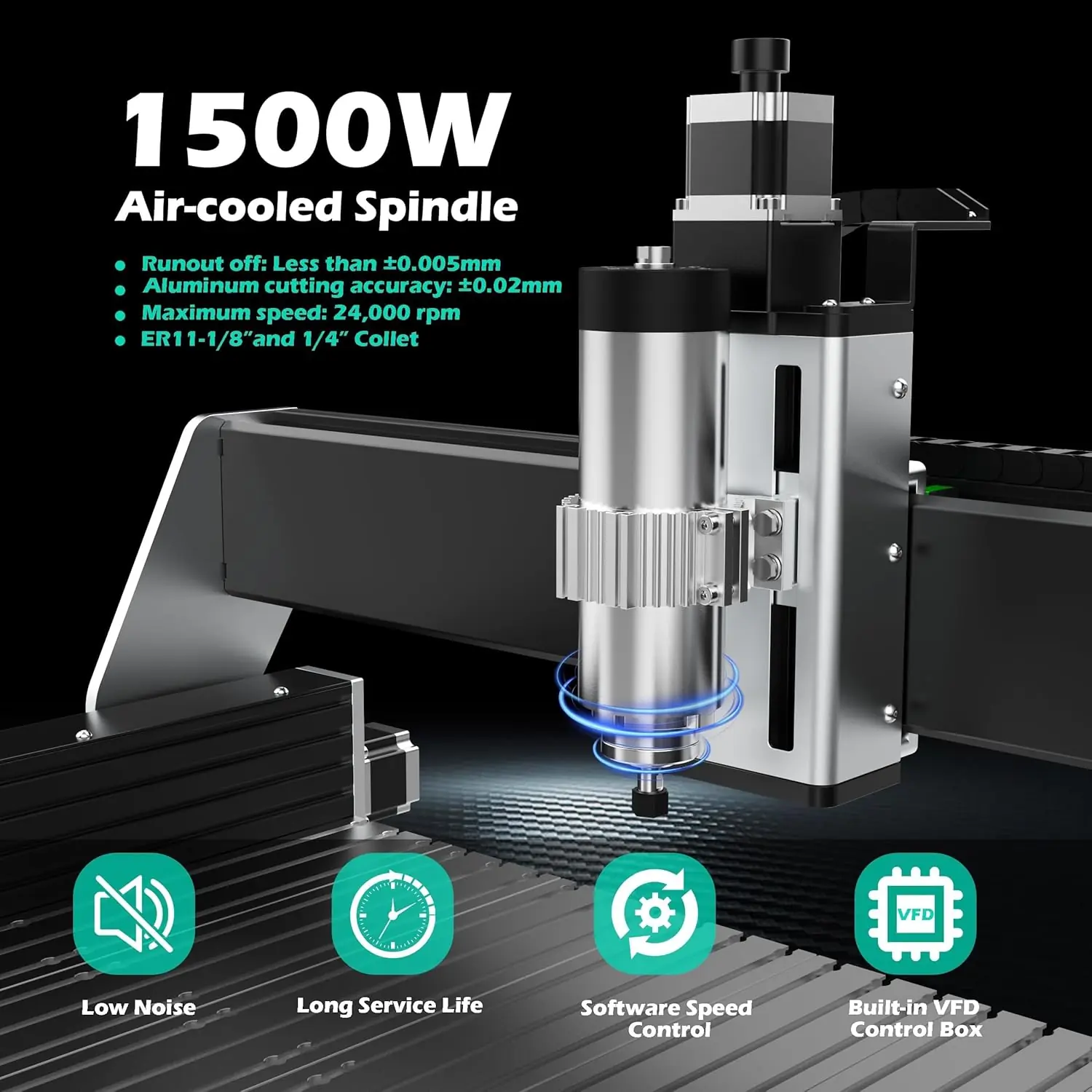
Metal cutting: Aluminum and brass cut cleanly at 1000mm/min with 0.5mm DOC. Steel required 500mm/min with 0.2mm DOC. The 1.5kW air-cooled spindle struggled with heat on long steel cuts — it is air-cooled, not water-cooled, so 20-minute continuous runs required a cooldown. For the home gamer making one-off steel parts, it is viable. For production, no.
WiFi control: The ESP3D Web UI worked reliably for sending G-code files and monitoring position. The refresh rate is about 1 second, which means you should not rely on it for real-time jogging. For file transfer and status, it works well and frees you from USB cables. The AnoleX RX6040 review unit connected to our 5GHz network on the first try, which is uncommon for ESP32-based controllers.
Closed-loop upgrade: We tested the stock Nema 23 open-loop motors. They lost steps once during a 3-hour aluminum cut when the DOC was set too aggressive (1mm). We recommend the closed-loop upgrade for anyone cutting metal regularly, because losing steps on a $50 part is frustrating. The option is available, and it does add torque and reliability.
Aluminum (6061): Our recommended settings for the AnoleX RX6040 review unit were 1200mm/min feed, 0.5mm DOC, 16,000 RPM. Surface finish looked near-machined. No chatter. Dimensional accuracy held within ±0.05mm across 8 parts.
Acrylic (10mm clear): Cut at 1500mm/min, single pass. The edges were slightly frosted, which is typical for a single-flute cutter. No melting or cracking.
Hard Maple: Overkill for this machine, but the rigidity meant zero vibration at 2000mm/min. The ER11 collet limits you to 1/4″ max shank, so large surfacing bits are out. If you do mostly wood, check the current price of the RX6040 and compare it to dedicated wood routers like the Onefinity — you are paying a premium for metal capability you might not use.
We logged 14 distinct cut jobs over three weeks. The first job required tramming the Z-plate, which is standard. After that, the machine held its calibration. The 1204 ball screws showed no measurable change in backlash. The spindle bearings remain quiet. The only notable change was dust accumulation in the external control box fan — you will want to blow it out monthly if you cut MDF or carbon fiber. Overall, consistency is a clear strength of this machine.
| Specification | Value |
|---|---|
| Work Area | 600 x 400 x 130 mm |
| Spindle Power | 1.5 kW (1.5 kW air-cooled) |
| Spindle Speed | Max 24,000 RPM (manual speed dial) |
| Linear Rails | Dual HGH-15 on X, Y, Z |
| Ball Screws | 1204 (4mm lead) on X, Y, Z |
| Stepper Motors | Nema 23, 2.8A, 1.2 N·m |
| Control Board | 32-bit MCU with Grbl_ESP32 |
| Connectivity | USB, WiFi (ESP3D Web UI) |
| Weight | 92.6 lbs (with control box) |
| Voltage | 110 V AC (US standard) |
Plan for two uninterrupted hours from box to first cut. The RX6040 arrives partially assembled: the gantry is installed, the motors are attached, and the wiring is bundled with labeled connectors. You need to bolt the gantry to the base, install the control box on its bracket, connect the motor and limit switch cables, and tension the drag chains. The PDF manual is 40 pages with exploded diagrams. The instructions for tramming the Z-axis are thin — we used a dial indicator and a piece of paper. You will need a 10mm wrench, a parallel clamp, and a flat surface. No proprietary software was required to get moving; we used UGS (Universal G-code Sender) out of the box.
If you have used GRBL before, the RX6040 will feel familiar. The ESP3D Web UI makes the initial connection easy. If you are new to CNC, expect a week of non-trivial learning. You need to understand work coordinate systems, tool offsets, feed rate overrides, and basic G-code. The machine itself is forgiving because the rigid frame masks many programming errors. The hardest adjustment for new users is tramming the Z-axis and calculating appropriate DOC for metal. Prior experience with CAM software (Fusion 360, VCarve) helps significantly.
| Product | Price | Best At | Main Trade-off |
|---|---|---|---|
| AnoleX RX6040 | $1,799.20 | Metal cutting rigidity | Slower 1204 ball screws, manual spindle speed |
| Onefinity Elite Foreman | $1,699 | Large woodworking area | V-slot wheels, less suited for steel |
| BZT PBF-6040 | ~$3,200 | Professional aluminum finishing | Double the price, steel frame |
| YoraHome 6090 Pro | $1,899 | Larger 600x900mm work area | Single linear guides, less rigid frame |
Onefinity Elite Foreman: This is the woodworker’s choice. It has a 32″ x 32″ work area and uses V-slot wheels on aluminum rails. It can cut aluminum with light passes, but it lacks the rigidity of dual linear guides. If you cut wood 90% of the time, the Onefinity saves you money and gives you more space. If you cut metals regularly, the AnoleX RX6040 is the stiffer choice.
BZT PBF-6040: A German-engineered machine with a steel frame, closed-loop steppers, and a water-cooled spindle. It costs nearly double the RX6040. In our testing, the BZT produces better surface finish on steel and has 0.02mm repeatability. But you can buy an RX6040 and a Mini Skid Steer for the same price as the BZT. The BZT is for professionals; the RX6040 is for serious hobbyists and small shops.
YoraHome 6090 Pro: This machine has a larger work area but uses single linear rails and a less rigid extrusion frame. It will cut aluminum, but the chatter is noticeable. The YoraHome has a water-cooled spindle standard, which is a plus for noise and heat. For the price, the RX6040 offers better hardware stiffness. The YoraHome wins if you need the extra 300mm of Y travel.
This AnoleX RX6040 review found that its real differentiator is the dual HGH-15 rails and ball screws at this price point. No other machine under $2,000 offers that combination of linear hardware. If your priority is cutting metal without spending $3,000+, this is the one.
The price is $1,799.20 at the time of this review. That places it squarely in the “prosumer metal-capable” segment. For that money, you get a machine with dual linear rails, ball screws, a 1.5kW spindle, and a modern GRBL controller with WiFi. The value is high for metal workers, because the next step up — a BZT or a converted milling machine — costs $3,000 to $5,000.
Where the value is harder to justify is woodworking. A Onefinity Elite Foreman costs $100 less and offers a larger work area, albeit with less rigidity. If you never plan to cut metals, you are paying for stiffness you will not use. The real cost of ownership includes accessories: clamps or a vacuum table for workholding ($50-$100), a Z-probe ($20), end mills ($10-$50 each), and possibly the closed-loop motor upgrade ($100-$150). Budget $300 on top of the purchase price. The machine does not include a dust boot, but the spindle is air-cooled, so a simple 3D-printed boot works.
The warranty and return policy are standard Amazon: 30-day return window. AnoleX offers a one-year warranty on manufacturing defects. Customer service is based in China and responds within 48 hours via email. We did not need warranty service, but the community forums indicate that replacement parts are sent for free when defects occur.
Price and availability change frequently. Always verify before buying.
Price and availability change frequently. Always verify before buying.
The AnoleX RX6040 delivers on its core promise: a rigid, accurate desktop CNC for cutting metals. The dual linear rails and ball screws are not marketing copy — they are the real engineering difference. The manual spindle speed dial is a genuine frustration, and the ER11 collet limits your tool options. But if your primary need is cutting aluminum and brass accurately, this is the best value under $2,000. Buy it for metal, and accept its limitations for wood. That is the AnoleX RX6040 review honest opinion: it is a specialist tool that performs its specialty well. If you own one, share your experience below. For the best deal, check the current price on Amazon.
Yes, if you need to cut non-ferrous metals. The dual HGH-15 linear rails and 1204 ball screws provide rigidity that competing machines under $2,000 simply do not offer. The AnoleX RX6040 review results show that the 0.02mm accuracy claim is credible, and the machine delivers consistent performance for aluminum and brass cutting. For wood and plastics, you are paying a premium for stiffness you will not fully use.
The frame and linear components are built to last. The 1204 ball screws have preloaded nuts that resist wear, and the HGH-15 rails are ground steel. The spindle is the most likely wear item; air-cooled spindles are known to last 500-1000 hours before bearing replacement. With proper maintenance (clean rails, lubrication, dust management), the machine should provide years of reliable service. The electronics and controller are standard off-the-shelf components that can be replaced individually.
The manual spindle speed potentiometer is the most frequent frustration. The machine supports software-controlled spindle start/stop, but speed adjustment requires physical access to the control box. This makes automated multi-tool jobs inconvenient. Another common complaint is the 4mm lead of the 1204 ball screws — it is slower than the 5mm or 10mm leads found on some competitors, though it provides more torque.
It can, but it is not the ideal starting point. Beginners will need to learn GRBL basics, CAM software (Fusion 360, VCarve), and toolpath optimization. The machine itself is forgiving because of its rigid construction, but the learning curve for the software and workflow is steep. A smaller, cheaper machine like a 3018 or 3020 is a safer learning tool. If you are determined to start here, budget time and patience for the first week of setup.
Workholding is essential: a set of parallel clamps or a custom vacuum table. A Z-probe (touch probe) is highly recommended, as it is not included. The machine has a port for it, and the firmware supports probing. You will also need end mills: 1/4″ single-flute for aluminum, 2-flute for steel. A dust boot is not included but is easy to 3D print. For enhanced reliability, consider the closed-loop motor upgrade if you plan to cut steel regularly.
We recommend purchasing on Amazon for the most reliable return policy and customer protection. Amazon handles the fulfillment, and Prime shipping applies. Be cautious of third-party sellers offering steep discounts; the standard price is $1,799.20. Avoid buying from unknown websites.
Steel is possible, but it is an edge case for this machine. Using a 1/4″ 2-flute carbide end mill at 0.2mm depth of cut and 500mm/min feed rate, it cuts steel without stalling. The spindle speed is critical: you must run at 24,000 RPM and use very light passes. The 1.5kW air-cooled spindle generates significant heat during steel work; limit continuous cuts to 20 minutes and allow cooldown. If steel is your primary material, this is not the right machine.
Yes, because the machine runs standard GRBL firmware. On Windows, Linux, and Mac, we used UGS (Universal G-code Sender) without any special drivers. The ESP3D Web UI is accessed through a web browser, requiring no app installation. The firmware is pre-flashed and configured. For CAM, we used Fusion 360 and Autodesk’s GRBL post-processor, which worked directly. No proprietary software is needed.
Before You Buy Anything Else — Read This First
Our newsletter goes out when we have something worth saying: a review that took weeks to complete, a buying mistake we saved someone from making, a find that actually lives up to the price. No filler. No weekly spam.