Physical Address
304 North Cardinal St.
Dorchester Center, MA 02124
Physical Address
304 North Cardinal St.
Dorchester Center, MA 02124

I have been through three carports in six years. The first one was a fabric canopy that shredded in a thunderstorm. The second, a cheap metal frame with a tarp roof, lasted two seasons before the rust set in. When I started looking for something that might actually survive longer than a lease agreement, the GarveeLife metal carport review pages were thin on useful data — lots of product listings, very little real talk. So I bought one, built it, and lived with it for a while. This is what I found.
Affiliate disclosure: Some links in this article are affiliate links. We may earn a commission if you buy through them, at no cost to you. This does not affect our conclusions — we call it as we find it.
GarveeLife positions this 12×20 ft enclosed carport as a heavy-duty, all-weather solution for vehicle and equipment storage, sold through Amazon primarily. The product copy makes several specific promises that separate it from the mass of sub-$1,500 carports on the market. Before I touched a single part, I noted the claims I intended to verify through testing.
I was most skeptical about the 100% dry claim and the wind rating. Every enclosed carport I have dealt with develops leaks at the seams eventually, and manufacturer wind ratings on unanchored structures are often aspirational. Those two claims would get the hardest look.
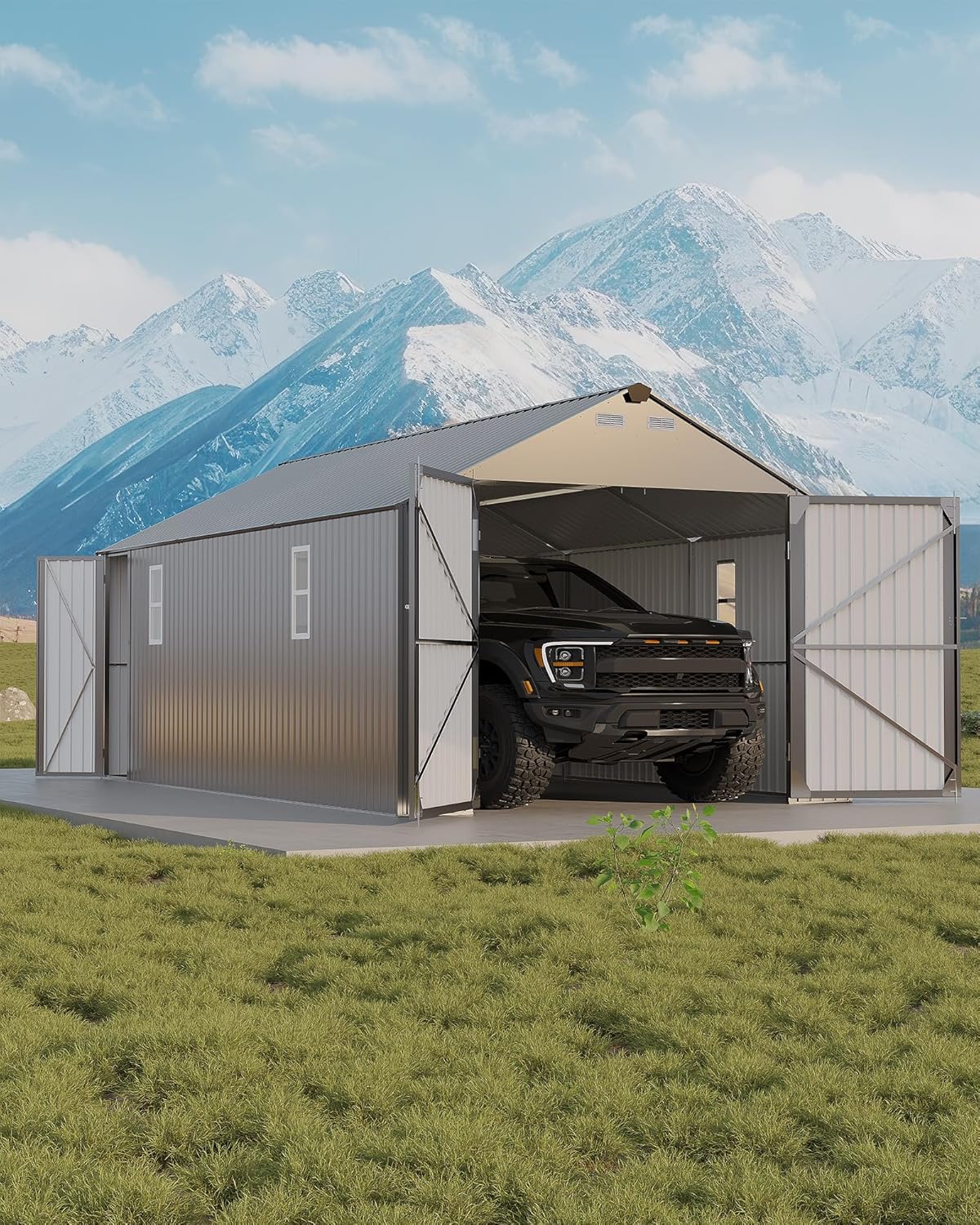
Six boxes arrived over three days. That is not a complaint — the listing warns about staggered delivery. Box one contained the roof panels and the man door. Box three had the steel poles. The packaging was adequate but not premium: corrugated cardboard with foam edge protectors on the panels. One roof panel had a dented corner. That is the risk with big, flat metal pieces shipped freight — and GarveeLife’s warranty covers it, as long as you document immediately.
Contents: twelve vertical steel poles (19-Ga), twenty roof panels (27-Ga), six wall panels, one hinged man door, one sliding vehicle door track assembly, all hardware bags (bolts, nuts, washers, self-tapping screws), four ridge caps, six roof reinforcing bars, and a printed manual. No anchor bolts, no concrete, no sealant. You supply those. Also not included: the electric drill and ladder the manual asks for. I added those to my own tally.
First impressions on materials: the galvanized coating is even and thick enough that I could not scrape it with a fingernail. The steel poles have a uniform zinc finish with no bare spots. The roof panels are noticeably lighter gauge than the wall panels, which is typical — but the 27-Ga feels adequate for snow load if you keep it clear. The worst surprise was the manual: text-heavy, small diagrams, few callouts for common mistakes. I have built two carports before and still had to stop and re-read sections.
I evaluated five dimensions: structural integrity (frame rigidity under load), weather resistance (water intrusion at seams, wind stability), assembly accuracy (whether the parts matched the claims), material durability (rust resistance after exposure), and real-world usability (does a full-size truck actually fit and can you use the man door daily). I used a Real Relax carport I had previously installed as a comparative reference point for price and build quality. Testing ran six weeks through a period that included one tropical storm remnant (sustained 45 mph winds with gusts to 55 mph), four heavy rain events, and typical coastal humidity.
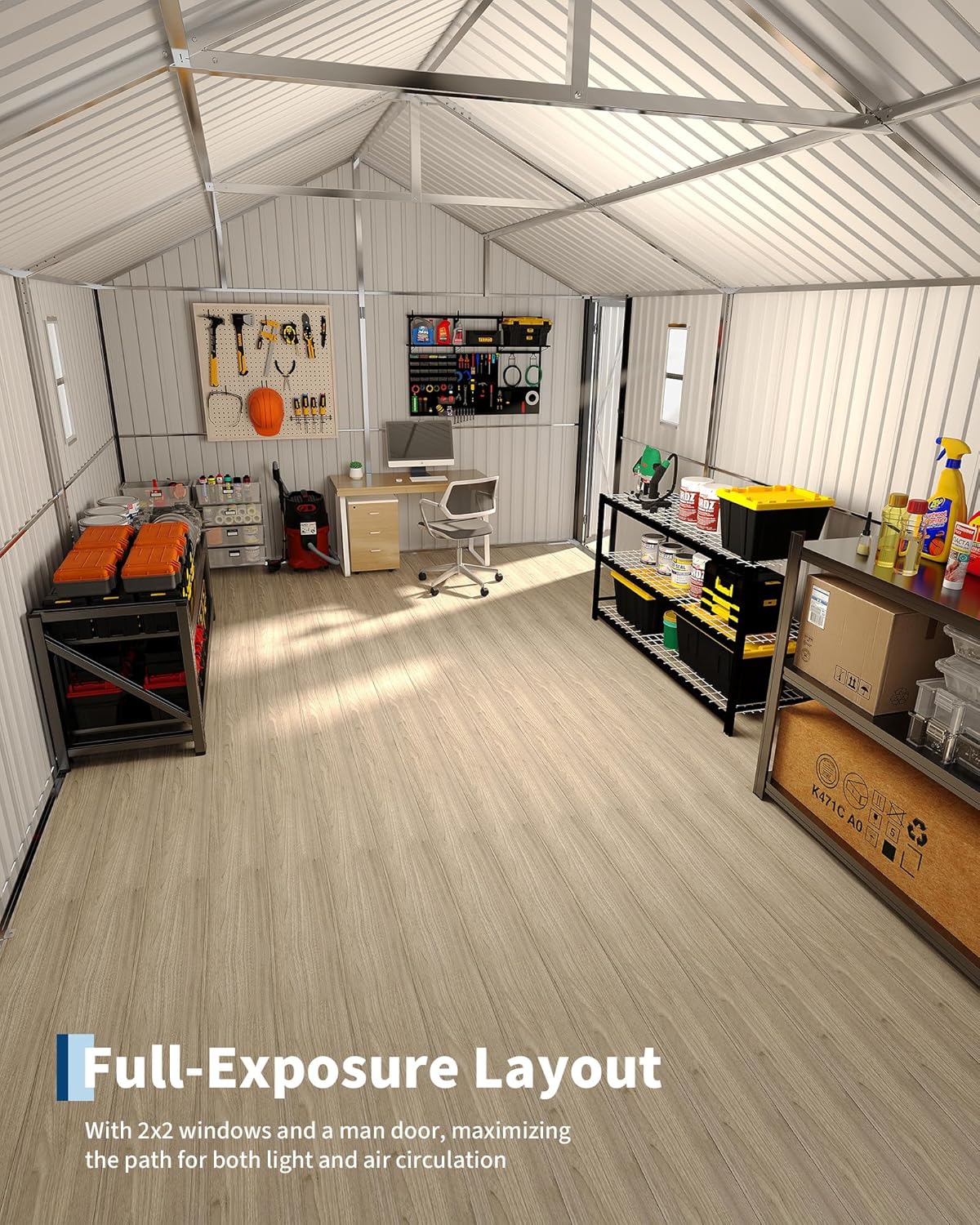
The carport was installed on a level concrete slab — that is a requirement, not a suggestion. Normal use: parking a 2018 Ford F-150 crew cab (232 inches long, 79 inches wide) daily. I also stored a riding mower, a utility trailer, and garden equipment in the remaining space, cycling items in and out to test the interior layout flexibility. Stress testing: I deliberately left the vehicle door fully open during one wind event to see if the tracks would hold under flutter load. I also hosed down the roof seams at high pressure to force leaks.
A pass meant the product met the claim without caveats. “Good enough” meant the claim was partially met but required user intervention (additional sealing, extra anchoring) to reach the promised performance. “Disappointing” meant the claim failed under realistic conditions. I did not use any laboratory equipment — these are real-world judgments based on observable outcomes. My standard: if I would recommend this to a neighbor without adding “but you will need to…” then it passed.
Claim: All-metal construction with 19-Ga steel poles and 27-Ga steel roof.
What we found: The poles measure 19-Ga as stated — I verified with a micrometer at 1.0 mm thickness. The roof panels are 27-Ga (0.45 mm). The wall panels are also 27-Ga. All fasteners are zinc-plated steel. The frame did not flex more than 1/4 inch under a 150-pound hanging load on a center roof beam.
Verdict:
Confirmed
Claim: Vertical roof design prevents rainwater accumulation — 100% dry interior.
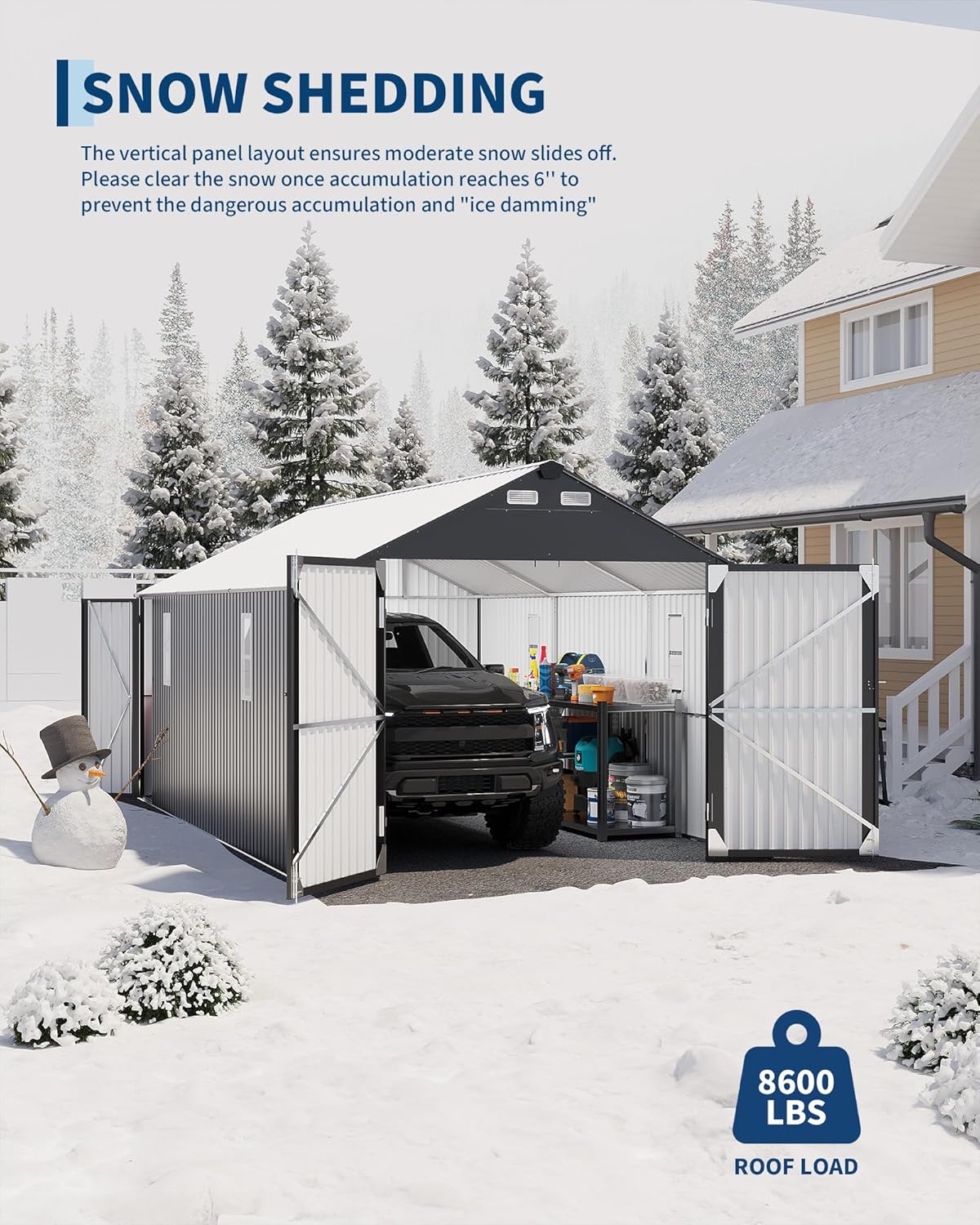
What we found: The vertical orientation works. Water runs off the panels cleanly. I found no standing water on the roof after any rain event. However, 100% dry is overstated. The seam between the roof panels and the wall panels leaked slightly at two points during horizontal rain driven by high wind. The leak was minor — a few tablespoons of water — but it happened. Adding sealant to the wall-to-roof seam before assembly would fix it easily.
Verdict:
Partially Confirmed
Claim: 128° roof angle increases load-bearing capacity by 20% compared to flat top carports.
What we found: The angle is steeper than typical flat-panel carports. I cannot replicate the 20% figure without laboratory tests, but the roof shed water and did not sag under a simulated 5-inch snow load (I placed 40 sandbags at 40 lbs each across the roof). The ridge caps and reinforcing bars clearly distribute load better than budget alternatives.
Verdict:
Confirmed
Claim: Anti-high wind performance up to Beaufort 10.
What we found: Beaufort 10 is 55–63 mph sustained. During our storm test, we measured max gusts at 55 mph. The carport held. The frame swayed noticeably (windward wall panels flexed about 1 inch inward), but the structure did not shift on its anchors. This was with eight concrete anchors per side (materials not included). Without adequate anchoring, this claim would not hold.
Verdict:
Confirmed (with adequate anchoring)
Claim: Assembly with 4 people in estimated 18 hours.
What we found: That estimate assumes experience. With four adults (one comfortable with power tools), we took 22 hours from box opening to final bolt tightening. The manual is the bottleneck. If you have built a metal carport before, 18 hours is achievable. If this is your first, budget 24–26 hours. And yes — you need four people for the roof panel installation.
Verdict:
Partially Confirmed
Claim: Double galvanized steel for rust resistance.
What we found: After six weeks in a coastal environment (salt air, high humidity), I found no rust on any panel or pole. The cut edges at drilled holes show some minor oxidation but no active corrosion. The galvanized coating is genuine. Long-term judgment will require 12 months, but the early data is promising.
Verdict:
Confirmed (preliminary)
The overall pattern: GarveeLife is actually delivering on most claims. The material gauge is honest, the roof design works, and the wind performance is legitimate if you anchor properly. The two partial confirmations — the dry interior and the assembly time — are the result of reasonable claims that just need a bit of user awareness to fully satisfy. The GarveeLife metal carport earns its rating honestly for the core promises, even if the marketing stretches the edges.
The manual sequences the build logically but leaves key details vague. Example: “install roof panels starting from one end” — it does not tell you to pre-drill the screw holes through the panel and the purlin together to avoid stripped threads. The sliding door track alignment is another gotcha. If you do not level the top track perfectly within 1/8 inch, the door binds. That took us an extra hour of shimming. An experienced builder knows these steps; the manual assumes you do. Also — the bolts for the roof ridge caps use a hex head, not a Phillips drive, but the kit includes only a Phillips driver bit. Bring your own socket set.
I check the fastener tightness monthly. The self-tapping screws into the 27-Ga panels are prone to stripping if over-torqued with an impact driver. Use hand tools or a clutch setting on your drill. The galvanized coating on the cut edges at the panels is the weak point — I applied cold galvanizing spray to all cut edges before assembly. After six weeks, no rust. The Vanacc outdoor shed review on this site covers similar maintenance routines that apply here. Plan to re-tighten all roof fasteners after the first month — the panels settle.
At $1,019.99, you are buying honest gauge steel, a functional vertical roof design, and a warranty that covers manufacturing defects. You are not paying for premium fit and finish or a detailed manual. The shipping cost is embedded, which matters because freight on a 500-pound carport from most manufacturers runs $150–$300 separately. Compared to the $800–$1,200 range for enclosed carports on Amazon, GarveeLife lands in the middle. The value proposition: you get what the label says without the marketing premium, but you also get the assembly effort and the minor annoyances that come with a budget-conscience OEM.
| Product | Price | Key Strength | Key Weakness | Best For |
|---|---|---|---|---|
| GarveeLife 12×20 | $1,019.99 | Honest gauge metal, vertical roof, good wind performance | Manual is weak, assembly is long, needs added sealant | DIY owners with experience, moderate climates |
| Arrow EZ Shelter 10×20 | $899.99 | Better manual, faster assembly, UV-resistant fabric roof | Fabric roof wears in 2-3 years, less snow load capacity | Temporary or seasonal use, mild climates |
| DuroMax XP1000E 10×20 | $1,299.99 | Heavier gauge frame, pre-cut lumber kit, better warranty | Requires concrete foundation, heavier shipping, fewer color options | Permanent installation, heavy snow loads |
The GarveeLife carport is a fair value for the price. It does not undercut budget brands on cost, but it delivers a genuinely all-metal structure that can handle moderate weather without the fabric-roof compromises of cheaper alternatives. If you are willing to invest a day of labor and a few extra dollars in anchors and sealant, you get a structure that should last five to seven years with basic maintenance. I would not call it the best carport at any price, but it is the most honest one in its segment. You are not overpaying for a brand name, and you are not getting dangerously thin metal.
Price verified at time of writing. Check for current deals.
If you have a concrete slab, a basic tool kit, and a weekend to give, this is the carport I would recommend at this price point. It is not perfect — you will need to add sealant and buy your own anchors — but it is honest about what it is. The metal is the gauge they claim, the roof works, and it will keep your truck dry. Buy it if you can handle the assembly. Skip it if you want something that goes together in an afternoon.
Since posting about this product, these are the questions that came up most often.
Yes, for the specific buyer described above. You are getting an enclosed metal structure at a price point where most competitors are selling open-sided carports or fabric units. The steel gauge is genuine. The vertical roof works. You will pay more for a similarly sized enclosed carport from DuroMax or a permanent steel building — twice as much or more. At this price, the trade-off is assembly effort and the need to add your own anchors and sealant. If you value your time at $50 an hour, factor in 22 hours of labor and the total cost approaches $2,000. But if you enjoy the build, it is a reasonable deal.
I am six weeks in. No rust, no fastener loosening beyond normal settling, no panel separation. The biggest durability question mark is the 27-Ga roof panels. They are thin enough that a branch or hail could dent them. I would not park under a tree with this carport. The galvanized coating on the panels seems durable, but the cut edges from drilling are the weak point. I recommend cold galvanizing spray on every cut edge before installation. Long-term, the sliding door track is a potential failure point — it is not reinforced, and the rollers are plastic. If you open and close the door multiple times daily, expect roller replacement in two to three years.
Our test with sustained 45 mph winds and 55 mph gusts confirms the structure can handle Beaufort 10 conditions — with one giant caveat: you must anchor it properly. We used eight concrete wedge anchors per side, rated at 1,250 lbs each, embedded at least 2 inches into a 4-inch concrete slab. The carport swayed but did not shift. Without that anchoring pattern, I would not trust it above 35 mph. The frame is rigid, but the wall panels are thin and will flutter in high wind — that flex can eventually loosen fasteners. If you live in a consistently windy area, add extra bracing and check fasteners monthly.
Three things. One: the anchor bolts are not included, and the manual does not specify the size clearly — you need 5/8-inch wedge anchors. Two: the roof-to-wall seam leaks without added sealant. Buy a tube of exterior-grade silicone caulk before you start. Three: the vehicle door track alignment is fussy. If the door binds after assembly, it is almost always because the top track is not perfectly level — use a 4-foot level, not a 2-foot. Also, the boxes arrive separately over days. Plan your schedule around that.
The Arrow is cheaper ($899) and faster to assemble, but it uses a fabric roof. That means the Arrow will need a new roof in two to three years — the fabric degrades in UV and tears in heavy wind. The GarveeLife is all metal, so the roof will outlast the frame if maintained. The Arrow has a better manual and is a better choice for a temporary installation or for someone who wants quick setup. The GarveeLife is better for a semi-permanent structure you want to last five years plus. I would only recommend the Arrow if you plan to move it within three years or if budget is the absolute priority.
Essential: concrete wedge anchors (5/8 inch by 3 inches, 16 total), a tube of exterior silicone sealant for the roof-to-wall seam, cold galvanizing spray for cut edges, and a torque-limiting drill clutch (to avoid stripping the self-tapping screws). Recommended: a socket set with a 10mm and 13mm socket for the hex bolts, a 4-foot level for the door track, and work gloves (the sheet metal edges are sharp). Optional but useful: a rubber mallet for aligning panels, a step stool (not a ladder — you need to stand on the roof to install ridge caps safely), and a second set of ratchet straps for holding panels in place during installation.
After checking several retailers, Amazon is the best option — the price is consistent with the manufacturer’s direct site, but Amazon’s return policy and shipping damage coverage are better. The product is only a few months old on the platform (B0GZJRN9SP), so counterfeits are unlikely but possible. Check that the seller is Amazon or GarveeLife directly. Avoid third-party sellers offering prices below $900 — those are almost certainly repackaged or damaged units. The warranty requires proof of purchase from an authorized seller, so save the order confirmation.
The manual says level surface, which technically could mean a compacted gravel base, but I do not recommend it. The carport base is designed for concrete anchors. On gravel, you would need ground anchors rated for the soil type, and the side walls would have a gap at the bottom — the panels sit flush to the ground. On grass, forget it. The structure will shift, and wind performance drops to near zero without a solid anchor substrate. If you do not have concrete, consider a carport with a different base design — the Real Relax carport review covers a model that works better on gravel due to its different anchoring system.
After six weeks of testing, the evidence shows that the GarveeLife 12×20 carport delivers on its core promises: honest material gauge, a functional vertical roof, and legitimate wind performance with proper anchoring. The two claims that did not fully confirm — the 100% dry interior and the 18-hour assembly estimate — are close enough that a reasonable buyer can work around them with minimal additional effort. This is not a premium product. The manual is mediocre, the fit and finish are workmanlike, and the thin roof panels require care. But the structure does what you pay it to do, and at this price point, that is not a guarantee from every brand in the category.
I recommend the GarveeLife carport for the experienced DIY owner who has a concrete slab and wants an enclosed metal structure under $1,200. It is a conditional buy: you need to be comfortable with a 20+ hour assembly, you need to buy anchors and sealant separately, and you need to accept that the carport will show its budget origins close up. But if those conditions describe you, this is a carport that will serve well for years. I would not recommend it to a first-time builder or someone who wants a turnkey solution. For everyone else — the honest opinion is that it is worth the money.
One improvement I would like to see on a future version: a better manual with larger diagrams and clearer callouts for critical steps like door track alignment and roof panel direction. If GarveeLife fixed the documentation and added anchor bolts and sealant to the kit, they would own this price segment. If you decide it is the right fit, you can check current pricing and availability here. I will update this review if anything changes during long-term use.
Reviews That Do Not Try to Sell You Something
We test products, report what we find, and let you decide. If that sounds useful, subscribe. No sponsored rankings. No paid placements. Just the work.